
Customer feedback surveys are one of the most powerful tools eCommerce brands can use to reduce return rates, improve customer satisfaction, and drive operational efficiency. This guide explains how to use CSAT (Customer Satisfaction) and return feedback surveys to uncover actionable insights, streamline your post-purchase flow, and create a more profitable customer experience.
Why Customer Feedback Surveys Matter in Your Return Flow
For most eCommerce brands, returns are unavoidable, but they’re also a source of valuable data. By treating returns as a feedback loop, you can identify issues within your product catalog, fulfillment process, or customer experience before they become costly trends.
Customer feedback surveys turn that loop into a measurable system. When built into your return flow, they allow you to listen, adapt, and continuously improve your operations.
Step 1: Measure Customer Satisfaction with CSAT Surveys
A Customer Satisfaction (CSAT) score measures how happy customers are after interacting with your brand, whether it’s a purchase, support request, or return. It’s one of the most widely used metrics for evaluating customer experience performance.
How to Collect Effective CSAT Feedback
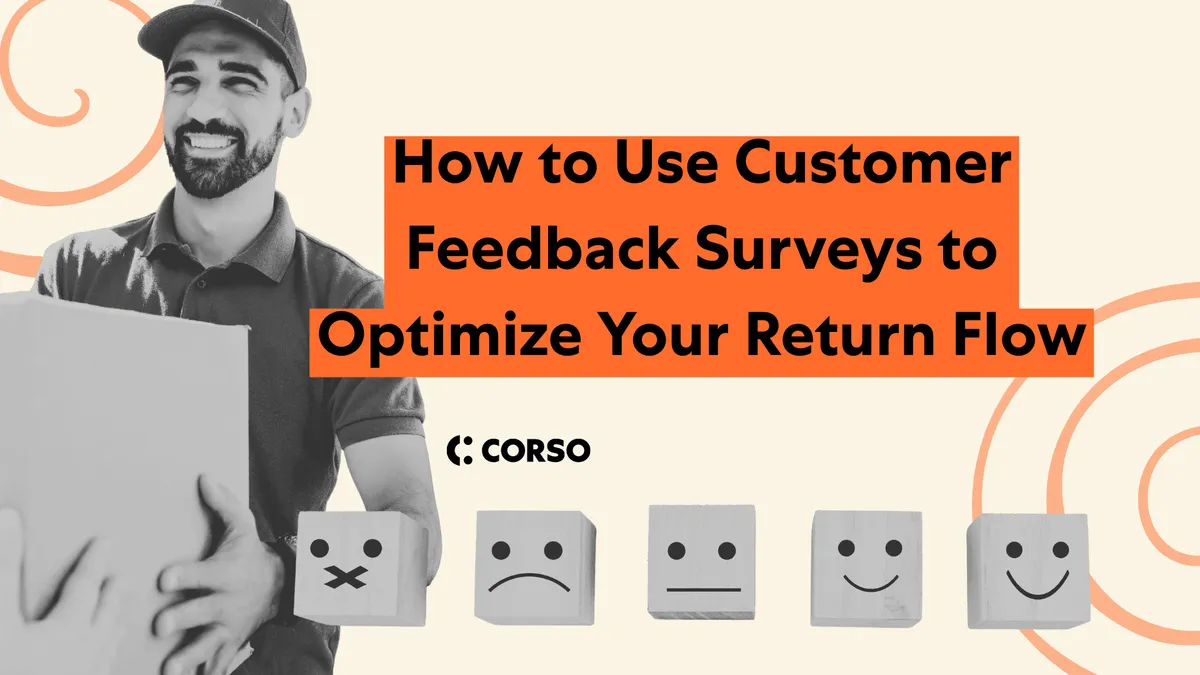
Keep your survey simple. Common formats include stars, smiley faces, or thumbs-up ratings. The most effective CSAT surveys balance quantitative feedback (a quick score) with qualitative insights (a brief comment field).
Adding an optional comment box is particularly valuable, it allows customers to share why they gave a certain rating without forcing them into a lengthy questionnaire.
Understanding CSAT Benchmarks
The definition of a “good” CSAT score varies by industry, but as a general rule:
- Anything above 70% indicates a strong customer experience.
- Scores between 50–70% suggest room for improvement.
- Anything below 50% signals a need for immediate attention.
In the United States, the average CSAT score is 78%. At Corso, the average is 98%, which was recognized by the Front Game Changer Award in both 2023 and 2024.
Average CSAT by industry:
- Consulting – 84%
- E-commerce & Retail – 82%
- Healthcare – 81%
- B2B Software – 77%
- Digital Marketing – 72%
- Education – 64%
- Internet Software – 50%
- Construction – 29%
- Consumer Services – 23%
- Communication & Media – 22%
Step 2: Integrate Return Feedback Surveys into Your Post-Purchase Flow
Traditional CSAT surveys measure satisfaction after an interaction, but return feedback surveys are integrated directly into the return experience. Together, they form what’s known as the Return Feedback Loop, a continuous cycle of collecting, analyzing, and acting on customer input.
A typical return flow includes five steps:
- Customer initiates a return
- Review of the return request
- Refund or exchange processing
- Documentation and confirmation
- Customer communication
Steps one and five are ideal opportunities for collecting feedback:
- Step 1 (Initiation): Capture why the customer is returning the product.
- Step 5 (Completion): Ask how satisfied they were with the return process itself.
These two data points, return reasons and satisfaction ratings, help identify bottlenecks, product issues, and communication gaps.
Step 3: Identify Patterns in Return Reasons
Each return reason provides insight into how your products and processes are performing. By analyzing recurring reasons, you can uncover patterns that point to larger operational or product-related challenges.
Common return reasons and how to act on them:
Item has a defect Investigate the manufacturing process. Are materials consistent? Are quality control checks in place? Repeated defects often point to supplier issues or production flaws.
It doesn’t fit Review your product pages. Are sizing charts clear and accurate? Are you providing measurements or fit reviews from past customers? Ensure product descriptions help shoppers choose correctly the first time.
I changed my mind Consider your positioning and pricing. Are customers switching to competitors? Does your product fulfill a clear need? Use this feedback to refine your brand messaging and value proposition.
I was sent the incorrect item Examine your fulfillment process. Can warehouse organization or packaging workflows be improved? Are SKU verification steps automated and accurate?
Shipping issue Assess your carriers and packaging. Are delivery times consistent with customer expectations? Are products arriving damaged? Look for opportunities to improve protection and reliability.
When creating custom return categories, avoid vague options such as “Other” or “Didn’t like it.” These responses rarely provide actionable insights and can dilute the quality of your data.
Step 4: Turn Return Feedback into Action
Consider a company that sells fruit-themed backpacks and apparel. A customer orders a strawberry backpack and a large papaya t-shirt. They return the backpack because they found a better price elsewhere and exchange the shirt for a smaller size.
From this single return, the company learns:
- Pricing competitiveness is influencing purchase decisions.
- Product sizing could be clearer on the product page.
By reviewing the customer’s feedback and return reasons, the brand can refine its pricing strategy, update product details, and improve the return experience, all based on real customer input.
This is the power of return feedback surveys: they transform returns from a loss into a learning opportunity.
Step 5: How to Get Started with Customer Feedback Surveys
If your brand is new to collecting customer feedback, start small and build gradually. Focus on one or two key moments in the post-purchase experience where feedback can have the greatest impact—returns, exchanges, or customer service interactions.
Here’s a simple roadmap to begin:
1. Choose your survey type and format
Decide whether to use a simple CSAT rating, a post-return feedback form, or both. Keep questions concise and easy to answer within 30 seconds.
2. Select the right tools or platform
Use an integrated system that automatically collects and categorizes responses. Corso’s Return Management, for example, allows you to collect feedback directly from the returns portal and track patterns over time.
3. Define your goals
Before launching surveys, identify what you want to learn. Are you focused on reducing return rates, improving shipping reliability, or enhancing product descriptions? Clear objectives will guide your survey design.
4. Automate the process
Embed surveys directly into your existing workflows so customers don’t have to go out of their way to respond. Automation ensures consistent data collection at scale.
5. Review and act on results
Schedule regular reviews, monthly or quarterly, to analyze trends. Look for recurring themes and address the top issues first. As you make improvements, keep measuring your CSAT to track progress.
Starting small and iterating based on feedback ensures your surveys remain meaningful and actionable, without overwhelming your team or your customers.
Step 6: Build a Continuous Feedback Loop
Once you begin collecting return feedback, the goal is to make it part of an ongoing improvement cycle:
- Collect feedback through automated CSAT and return surveys.
- Categorize responses by issue type—product, fulfillment, communication, or experience.
- Analyze trends over time to spot recurring challenges.
- Implement changes and monitor how they affect return rates and CSAT scores.
- Reassess regularly to ensure improvements have lasting impact.
Key Takeaways for eCommerce Leaders
- Integrate customer feedback surveys at key post-purchase touchpoints.
- Use both CSAT and return feedback data to diagnose operational inefficiencies.
- Identify patterns across return reasons to guide product or process updates.
- Benchmark your CSAT score against industry averages to track progress.
- Leverage technology like Corso’s Return Management to automate data collection and reporting.
The Bottom Line
For Shopify and eCommerce brands, returns are more than a logistical process—they’re a direct source of customer insight. By embedding customer feedback surveys into your return flow, you gain the data needed to reduce friction, enhance satisfaction, and strengthen customer loyalty.
Returns aren’t the end of the customer journey. They’re the start of a smarter, more informed one.
Frequently Asked Questions
What are customer feedback surveys?
Customer feedback surveys are short questionnaires designed to measure satisfaction and gather insights about a customer’s experience with your brand. They often include rating scales, comment fields, or specific questions about the purchase, return, or support process. When used effectively, they provide direct input to help brands improve their products, communication, and post-purchase operations.
How can customer feedback surveys improve my return flow?
Customer feedback surveys help you understand why returns happen and how customers feel about the process. By analyzing survey data, brands can identify product quality issues, fulfillment errors, or communication gaps that lead to returns. This information allows you to make informed changes that reduce return rates and improve customer satisfaction.
What is a good CSAT score for eCommerce brands?
A good CSAT (Customer Satisfaction) score for eCommerce brands is generally above 70%. Scores between 50% and 70% suggest room for improvement, while anything below 50% indicates that the customer experience or return process needs attention. The average CSAT in the U.S. is around 78%.
When should I collect return feedback from customers?
The best time to collect return feedback is at two points in the return flow. First, when a customer initiates a return, ask for the reason behind it. Second, once the return or exchange is complete, ask how satisfied they were with the process. These two moments provide both product-level and experience-level insights that can help refine your operations.
How do I get started with customer feedback surveys?
Start by defining your goal—what do you want to learn or improve? Then choose a simple survey format, such as a CSAT rating or short return feedback form. Use an integrated platform that automates feedback collection within your existing return or support workflows. Review the results regularly, identify patterns, and take action on the top issues.
What tools can help automate customer feedback collection?
Tools like Corso’s Return Management automate the process of collecting and categorizing customer feedback. These platforms can integrate surveys directly into your return portal, analyze return reasons, and generate insights that help you enhance your product experience, reduce returns, and build customer loyalty.